What is the interviewer testing?
Whether you can advocate for yourself with evidence, tied to what this role needs, without arrogance or false modesty.
The question is a closing summary in disguise. The interviewer wants to hear you connect two or three things the role needs with two or three things you have done, and to see whether you can do that plainly. The follow-ups are about the edges: “What unique perspective do you bring?” and “What would you need to develop most in your first year?” The second one is a gift. An answer that names its own gap is more believable than one that has none.
How should I structure the answer?
Pick two or three things the role needs, match each with one piece of evidence, and end with the one thing you will need to learn.
- What the role needs. From the ad, the website or the conversation so far. Two or three things, said in their words.
- Your evidence, one item each. A thing you did, with a result, that shows the quality. Not an adjective: a sentence someone could check.
- The thing you bring that they did not ask for. Optional, and only if it is real: a language, an industry you worked in, a perspective from a different degree.
- The gap. One sentence on what you will need to learn in the first year. It makes the rest credible.
What does a good answer sound like?
Three needs, three pieces of evidence, and an honest gap; the example below shows the shape.
“From the ad and from what you have described, this role needs someone who can write clearly for different audiences, keep several campaigns moving at once, and read the numbers behind them. On the writing: for the last year I have run the student society’s newsletter, and the open rate went up after I rewrote the subject lines and cut the length, which I can show you. On juggling: I carried four units and a part-time job through the whole degree without dropping a deadline, which is less glamorous than it sounds but is the skill. On the numbers: my major was marketing with two statistics units, and in my internship I built the weekly report that told the team which posts were actually driving sign-ups. What I would need to learn first is your paid-media tooling, which I have only seen from the outside. I would rather tell you that than find out in month two that you expected otherwise.”
The example takes the needs from the employer’s own words, gives one checkable piece of evidence per need, and ends with a gap stated plainly. No “I’m a hard worker”, no comparison with other candidates.
What are the common mistakes?
A list of qualities with no evidence, overstating, comparing yourself with other candidates, “I’ll work harder than anyone”, and false modesty.
- The adjective list. “I’m hard-working, a fast learner and a team player.” Every applicant says it; none of it is evidence.
- Overstating. A claim the interviewer can test in the next question, and will.
- Comparing. You have not met the other candidates. Talk about the role and about you.
- Effort as the pitch. Working harder than anyone is not a skill, and it invites the question of what you would do with the extra hours.
- False modesty. “I’m not sure you should” is not charming. The question asked for a case; make it.
How do I practise this question?
Answer it out loud on camera, read the transcript back, and fix one thing at a time.
The answer in your head and the answer that leaves your mouth are different things, and the transcript is where you find out which parts arrived. Veracue gives you the transcript, the length, your pace and filler words, and what you said scored against a rubric, with the one thing to fix first.
Two answers are free when you practise your interview on camera with Veracue; the Pro, Interview Sprint and Premium plans add more answers, formal interviews and the Veracue Challenge.
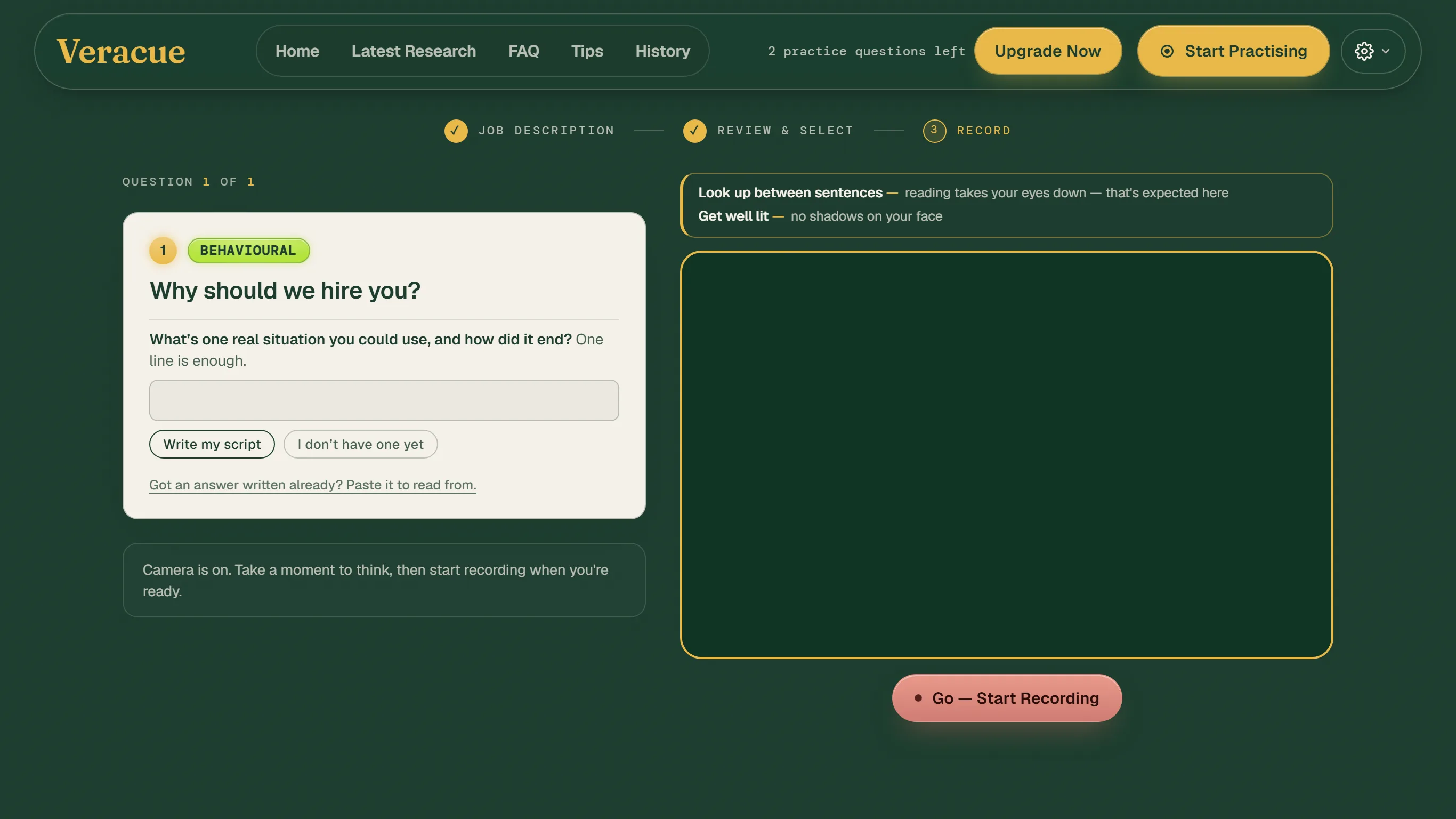
Opens the practice page with “Why should we hire you?” loaded, the question bank’s wording of it. Two free answers with full Pro feedback; no card needed. New here? You’ll create an account first and land on the question.
Where does this advice come from?
From the sources below, from the question bank’s notes on what interviewers test with this question, and from what practice answers on Veracue show.
- Job interview, Wikipedia: what interviewers assess and how impressions form.
- Structuring an answer under pressure, Veracue: the shapes that survive nerves.
- How to prepare for a clerkship interview, Veracue: the whole interview, question type by question type.