Which interview practice tool should I use?
It depends on what you are missing: a conversation that pushes back, a curriculum from your uni, a free question bank, or scored feedback on one recorded answer.
This page is written by the person who built one of the tools on it, so read it with that in mind. The rule for every competitor line is that it was read from that company’s own website on the date given, and quoted phrases are theirs; where a site does not say something, the line says so rather than guessing. The feature-by-feature table has the detail for four of them; this page is the shorter, plainer version with the trade-offs said out loud. Last checked: competitor facts 13 October 2026, Google Interview Warmup 21 October 2026.
What does each tool do best?
Yoodli for a live roleplay, Big Interview if your uni provides it, Huru for a free question bank, and Veracue for one recorded answer scored on content and delivery.
Yoodli
A live roleplay: it asks follow-up questions based on what you just said, with a choice of interviewer demeanour, and gives feedback on your answers and delivery. If what you want is a conversation that pushes back, this is the one to look at; none of the others on this page does it. Pricing on its site was Pro at US$8 a month billed annually, with up to ten roleplays a week, and Advanced at US$20 a month billed annually, unlimited; monthly prices were not stated. It is also priced for teams and organisations. Web app, with meeting-platform integrations; a mobile app was not stated.
Big Interview
The university network. It says 700+ institutions use it, with assignments, a curriculum of video lessons and an interview simulator with “realistic questions and conditions”, and its video AI analyses “answer quality” among other things. If your uni or college provides it, you may already have access, and that is the reason to use it. The scoring rubric, and whether its simulator asks follow-ups, were not stated.
Huru
Free for job seekers, “no subscription”, with a very large question bank (“50,000+ questions” for “242+ career roles”) and a Chrome extension that builds questions from a job posting. It scores the content of each answer and tracks progress across takes. It does not say it analyses your face or voice, and it does not say it rewrites your answer. If cost is the deciding factor, start here.
Google Interview Warmup
A free tool from Grow with Google that let you answer a short set of questions out loud and read a transcript back. Its address now redirects to a general interview-tips article on grow.google, and Google has published no notice about closing it that we could find. Third-party reports say it was retired in 2026. If you were looking for it, the alternatives page covers what to use instead.
Veracue
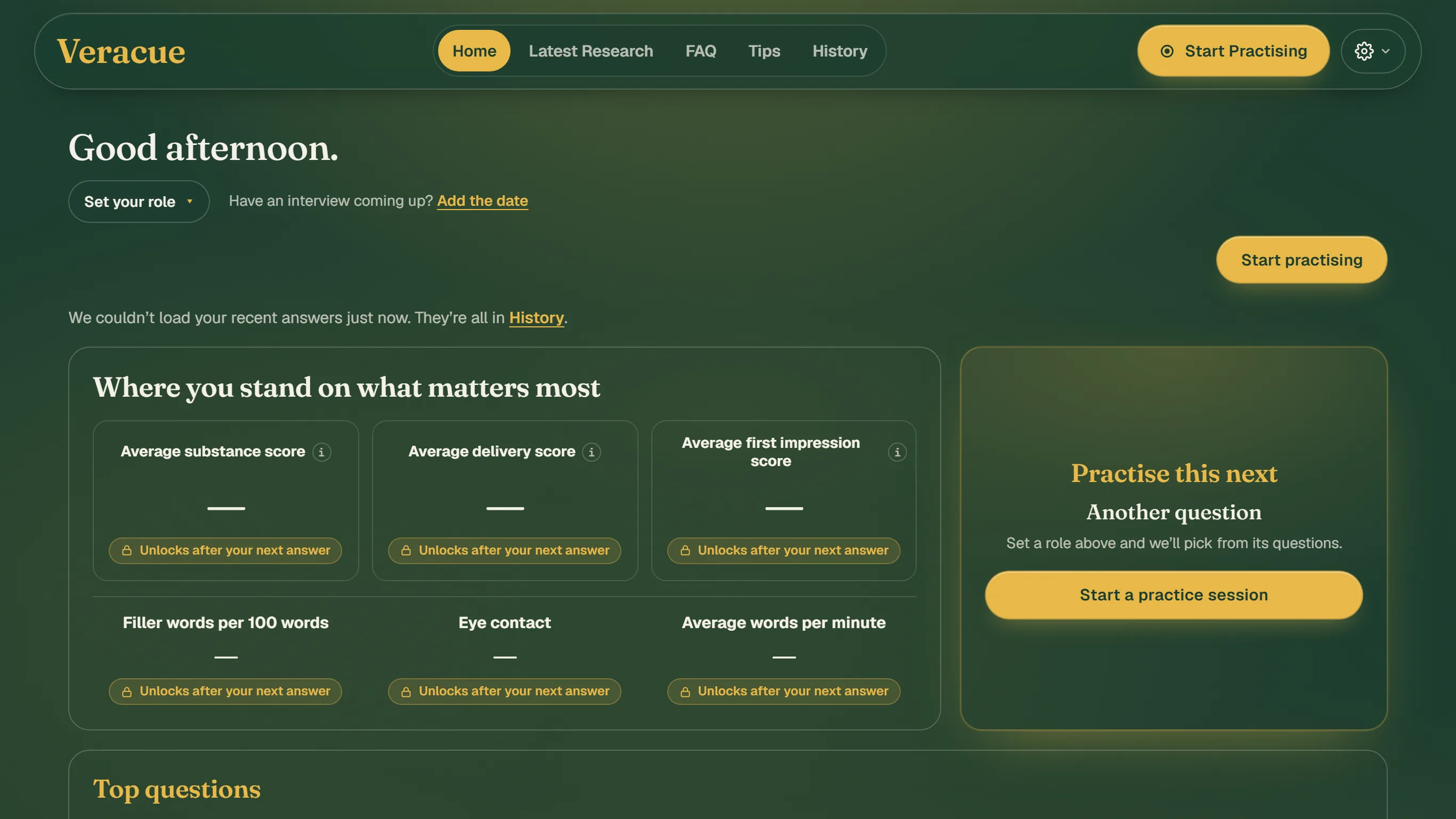
Ours, so the plainest description we can give: you answer real interview questions on camera and get feedback on what you said (scored against a rubric: did you answer the question, real examples, structure, your own part in it), your eye contact, pace and filler words, and what your face and voice did at which words, with one #1 thing to fix and a stronger script written from your own answer for a second go. No live roleplay and no follow-up questions; a formal-interview mode on paid plans asks unseen questions aloud back to back, which is the nearest thing. Two answers are free with full Pro feedback; Pro is $29 USD a month, or $42 AUD in Australia. Made in Australia; works anywhere in English. Where it is weaker than the others: no conversation that reacts to you, and no university curriculum.
How do I choose?
Pick by the practice you are missing: a reacting interviewer, a course, a free bank, or honest feedback on a recorded answer. Most people need the last one first.
- You freeze when the interviewer reacts. Yoodli’s roleplay, then record the same answers on Veracue to see what they looked like.
- Your uni gives you Big Interview. Use it; it is paid for. Add a recorded-answer tool when you want the content of one answer scored.
- You cannot spend anything. Huru, plus Veracue’s two free answers for the delivery side.
- You have one interview in a fortnight. Record the questions you expect, fix the one thing each result names, and repeat. That is what Veracue is built for.
Where do these facts come from?
Each company’s own website, read on the date given, with quoted phrases theirs; and the Veracue pricing page for ours.
- Yoodli, read 13 October 2026.
- Big Interview, read 13 October 2026.
- Huru, read 13 October 2026.
- grow.google/interview-warmup, which redirected to a general interview-tips article when fetched on 21 October 2026.
- Veracue vs Yoodli vs Big Interview vs Huru, the feature-by-feature table.
- Veracue plans and prices.