What is the interviewer testing?
Whether you know a real weakness of yours, whether it is relevant to work, and whether you are doing something about it now.
The interviewer is not hunting for a reason to reject you. They are checking for self-awareness, which predicts whether you will take feedback well, and for a growth habit, which predicts whether you will improve. The follow-ups tell you so: “What steps are you taking to address it?” and “How has it affected your work?” A weakness you have never done anything about, or one that has never cost you anything, is not the one to pick.
How should I structure the answer?
A real weakness that matters at work but would not sink the role, one time it cost you, what you do now, and a sign it is improving.
- The weakness, named plainly. One sentence, no cushioning. It should be true, relevant to work, and not the core skill of the job you are applying for.
- One instance. A time it cost you or someone else something. This is what makes it a real weakness rather than a label.
- What you do now. A concrete habit, not an intention: a rule, a check, a question you ask.
- The sign. One recent time the habit held. Keep it modest; “it is better, not fixed” is the believable version.
What does a good answer sound like?
A named weakness with a cost, a specific habit, and a modest sign of improvement; the example below shows the shape.
“I ask for help too late. In my paralegal role I spent most of a day trying to find a document in the matter system because I didn’t want to interrupt the solicitor, and when I finally asked, she found it in two minutes and I’d lost the afternoon on something that mattered to her deadline. The rule I use now is twenty minutes: if I am stuck after twenty minutes, I write down what I have tried and ask, with the list, so the question costs the other person as little as possible. It is better rather than fixed; last month I asked at the twenty-minute mark on a research task and the solicitor pointed me to a precedent I would never have found.”
The example names a weakness an interviewer would believe, shows it costing something, gives a rule with a number in it, and ends on a modest, checkable improvement.
What are the common mistakes?
A strength in disguise, a weakness that does not matter at work, one that disqualifies you for the role, and no habit afterwards.
- “I’m a perfectionist” and “I work too hard.” Everyone in the room knows what these are. They cost you the credibility the rest of the interview needs.
- The irrelevant one. “I’m bad at parking.” True, maybe; not what was asked.
- The disqualifying one. “Attention to detail” for a paralegal role answers a different question than the one you want to be answering.
- The intention. “I’m working on it” with nothing specific is a label, not a habit.
- The confession. One weakness, handled well, is the answer. A list is not.
How do I practise this question?
Answer it out loud on camera, read the transcript back, and fix one thing at a time.
The answer in your head and the answer that leaves your mouth are different things, and the transcript is where you find out which parts arrived. Veracue gives you the transcript, the length, your pace and filler words, and what you said scored against a rubric, with the one thing to fix first.
Two answers are free when you practise your interview on camera with Veracue; the Pro, Interview Sprint and Premium plans add more answers, formal interviews and the Veracue Challenge.
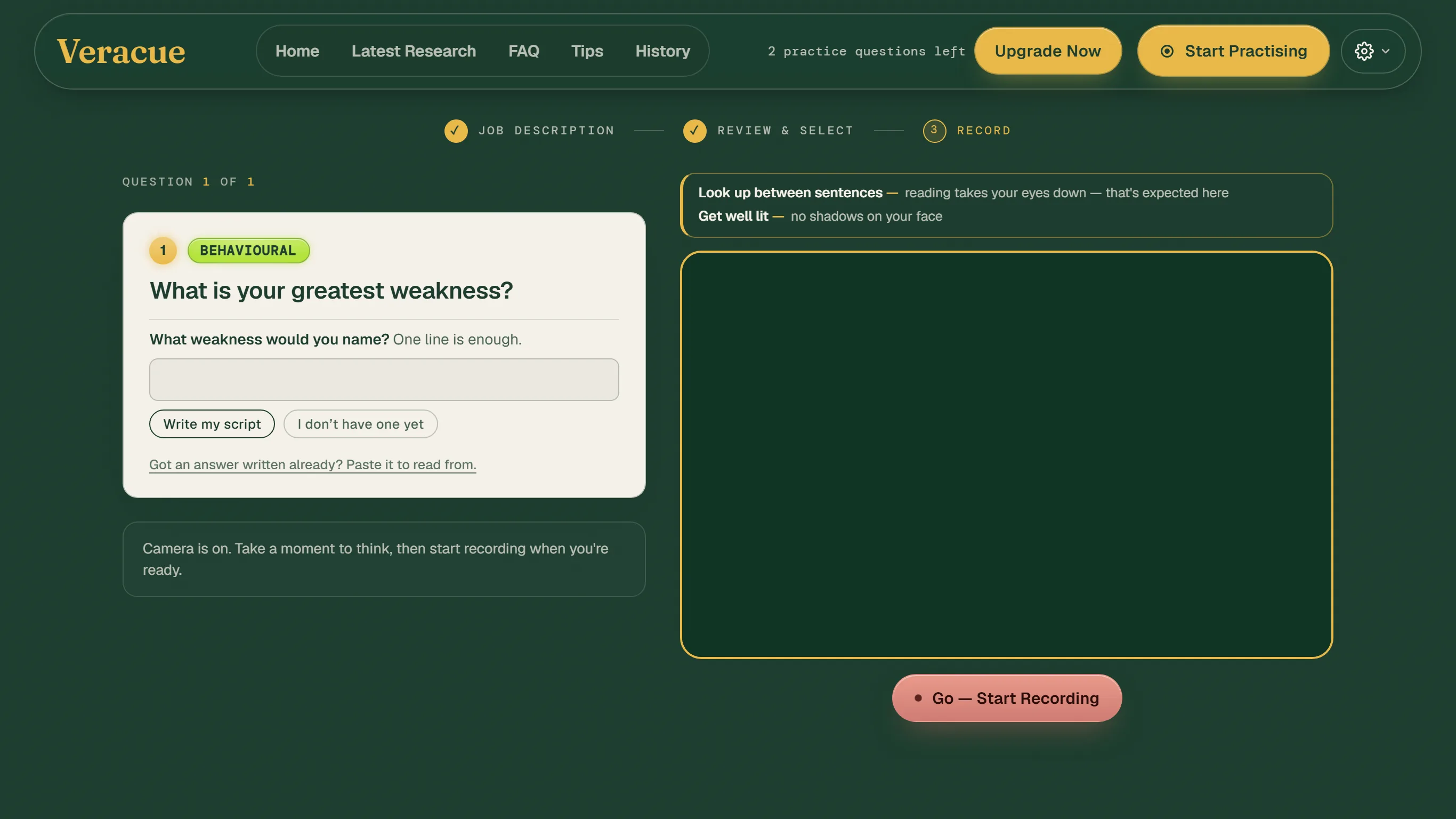
Opens the practice page with “What is your greatest weakness?” loaded, the question bank’s wording of it. Two free answers with full Pro feedback; no card needed. New here? You’ll create an account first and land on the question.
Where does this advice come from?
From the sources below, from the question bank’s notes on what interviewers test with this question, and from what practice answers on Veracue show.
- Job interview, Wikipedia: what interviewers assess and how impressions form.
- Structuring an answer under pressure, Veracue: the shapes that survive nerves.
- Behavioural interview questions: how to structure answers that land, Veracue: STAR in full, with before-and-after examples.