What is the interviewer testing?
Whether you take ownership, whether you fixed it properly, and whether you have a habit now that stops it happening again.
Nobody expects a graduate to have made no mistakes. The interviewer is listening for three things: that you name a real one without flinching, that your first move was to tell someone and fix it rather than hope nobody noticed, and that something in how you work changed afterwards. The follow-ups say it plainly: “What did you learn?” and “How did you make sure it didn’t happen again?” An answer with no habit at the end has not finished.
How should I structure the answer?
Four beats: the mistake in one sentence, what you did in the next hour, the fix, and the habit you have kept since.
- The mistake, one sentence. Real, specific, and yours. Not catastrophic, not trivial: a mistake with a consequence someone else felt.
- The next hour. Who you told, how fast, and what you checked. The order matters: telling the person affected before they find out is the single most convincing thing in this answer.
- The fix. What you did to put it right, including anything beyond the one error, like checking whether it had happened elsewhere.
- The habit. One concrete change in how you work, and if you can, a time it has caught something since.
What does a good answer sound like?
A real error, owned quickly, fixed thoroughly, with a durable habit at the end; the example below shows the shape.
“In my paralegal job I sent a client the wrong version of a lease summary: an earlier draft with a rent figure that had since been corrected. I realised about twenty minutes later when I reopened the file. I rang the supervising solicitor straight away and told her what I’d sent, then emailed the client the right version with a one-line note saying the earlier figure was a draft and this one was correct, before the client had replied to the first. I also went back through that week’s outgoing emails to check I hadn’t done it anywhere else; I hadn’t. Since then I name every file with its date and status in the filename and I don’t attach anything from a folder called Drafts. That habit caught a colleague’s wrong attachment last month before it went out.”
Notice the order: realised, told, fixed, checked wider, changed a habit, with evidence the habit works. No “I’m a perfectionist”, and no minimising.
What are the common mistakes?
A non-mistake dressed as one, a trivial one, a catastrophic one with no recovery, blame shared around, and no habit at the end.
- “I’m a bit of a perfectionist, so…” The interviewer has heard it, and it reads as evasion.
- The wrong attachment, full stop. Trivial is fine only if the recovery and the habit are not. An answer that ends at “I apologised” is too small.
- The disaster. A mistake with no recovery in the story leaves the interviewer with the disaster and nothing else.
- Shared blame. “The process was unclear” may be true. Say what you did anyway.
- No habit. “I was more careful after that” is not a habit. Name the thing you do differently.
How do I practise this question?
Answer it out loud on camera, read the transcript back, and fix one thing at a time.
The answer in your head and the answer that leaves your mouth are different things, and the transcript is where you find out which parts arrived. Veracue gives you the transcript, the length, your pace and filler words, and what you said scored against a rubric, with the one thing to fix first.
Two answers are free when you practise your interview on camera with Veracue; the Pro, Interview Sprint and Premium plans add more answers, formal interviews and the Veracue Challenge.
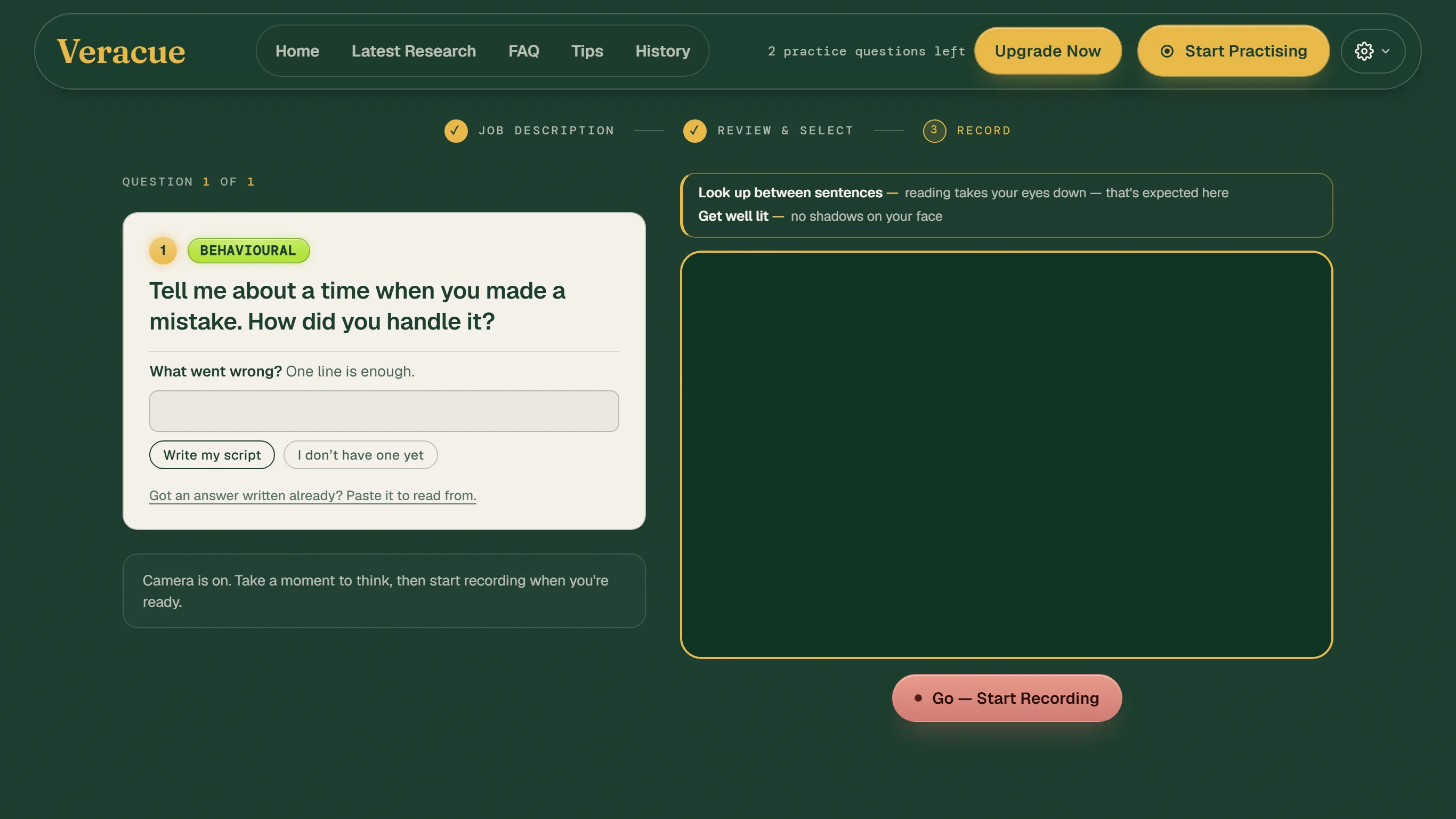
Opens the practice page with “Tell me about a time when you made a mistake. How did you handle it?” loaded, the question bank’s wording of it. Two free answers with full Pro feedback; no card needed. New here? You’ll create an account first and land on the question.
Where does this advice come from?
From the sources below, from the question bank’s notes on what interviewers test with this question, and from what practice answers on Veracue show.
- Situation, task, action, result, Wikipedia: the STAR structure and where it came from.
- Job interview, Wikipedia: what interviewers assess and how impressions form.
- Behavioural interview questions: how to structure answers that land, Veracue: STAR in full, with before-and-after examples.