What is the interviewer testing?
Whether you have a real reason that connects something true about you to something specific about this role, and whether you have done the thinking.
Interviewers ask this because motivation predicts what happens after the offer: whether you turn up curious in month three, whether you stay past the first hard patch. They are listening for two things. The first is specificity: does the answer name something about this role, this team or this employer that you could not say about the one across the road? The second is a cause: is there a moment, a job, a class, a person, that explains why you want this kind of work, or only an adjective? “Passionate about problem-solving” tells them nothing; a story about the afternoon you found the error in a supplier’s invoices and could not let it go tells them a lot.
How should I structure the answer?
Three parts: the moment that made you want this kind of work, what you did about it since, and the one thing about this role that made you apply.
- The moment. One real time, told briefly, when you discovered you liked this kind of work or were good at it. A class, a job, a project, a person. This is the part that makes the answer yours.
- What you did about it. One or two sentences on how you followed that up: a subject you chose, a part-time job, a competition, a conversation. Evidence that the interest survived contact with the work.
- Why this role. The one specific thing here that made you apply: the rotation structure, the kind of client, the size of the team, a piece of their work you read about. If the sentence would survive a find-and-replace on the employer’s name, it is not finished.
Keep it to about a minute. The shape is the same one the clerkship guide recommends for “why this firm”, and the same one Veracue asks about before it writes you a script for a motivation question: one real moment first, and the reasons follow from it.
What does a good answer sound like?
A real moment, the follow-through, and one specific reason for this role; the example below shows the shape.
“The honest start was a second-year statistics assignment where we were given a council’s water-usage data and asked to find anything worth reporting. I found that one suburb’s usage doubled every January, worked out it was the holiday rentals, and I remember being annoyed when the semester ended because I wanted to keep going. Since then I’ve taken every data subject I could, and last summer I did a vacation placement with a logistics company where I built the weekly delivery report they still use. What made me apply here specifically is that the graduate analyst role sits inside the operations team rather than a separate reporting function, so the people asking the questions are the ones who act on the answers. That is the part of the placement I liked most, and this role has it on day one.”
The example never says the word “passionate”. The moment carries the motivation, the placement proves it held, and the last two sentences could only be about this employer.
What are the common mistakes?
Reasons that fit every employer, praise of the company instead of a reason of your own, an answer only about what you will gain, and “I need a job”.
- The universal answer. “A great culture, global reach and opportunities to grow.” Every employer in the city says this about itself; it is not a reason.
- Reciting their website back. They know what they do. The question is why that matters to you.
- All take, no give. An answer made entirely of what the role will do for you leaves the interviewer wondering what you will do for them. The moment and the follow-through are what answer that.
- Honesty without selection. “It was the first graduate programme that replied” may be true. It is not the whole truth, and the whole truth is what the shape above draws out.
- Over-rehearsal. A memorised answer collapses the moment the question is phrased as “What drew you to us?” instead. Prepare the moment and the reason, not the wording.
How do I practise this question?
Record it on camera, then read the transcript and check that a real moment is in it and that the last sentence names this role.
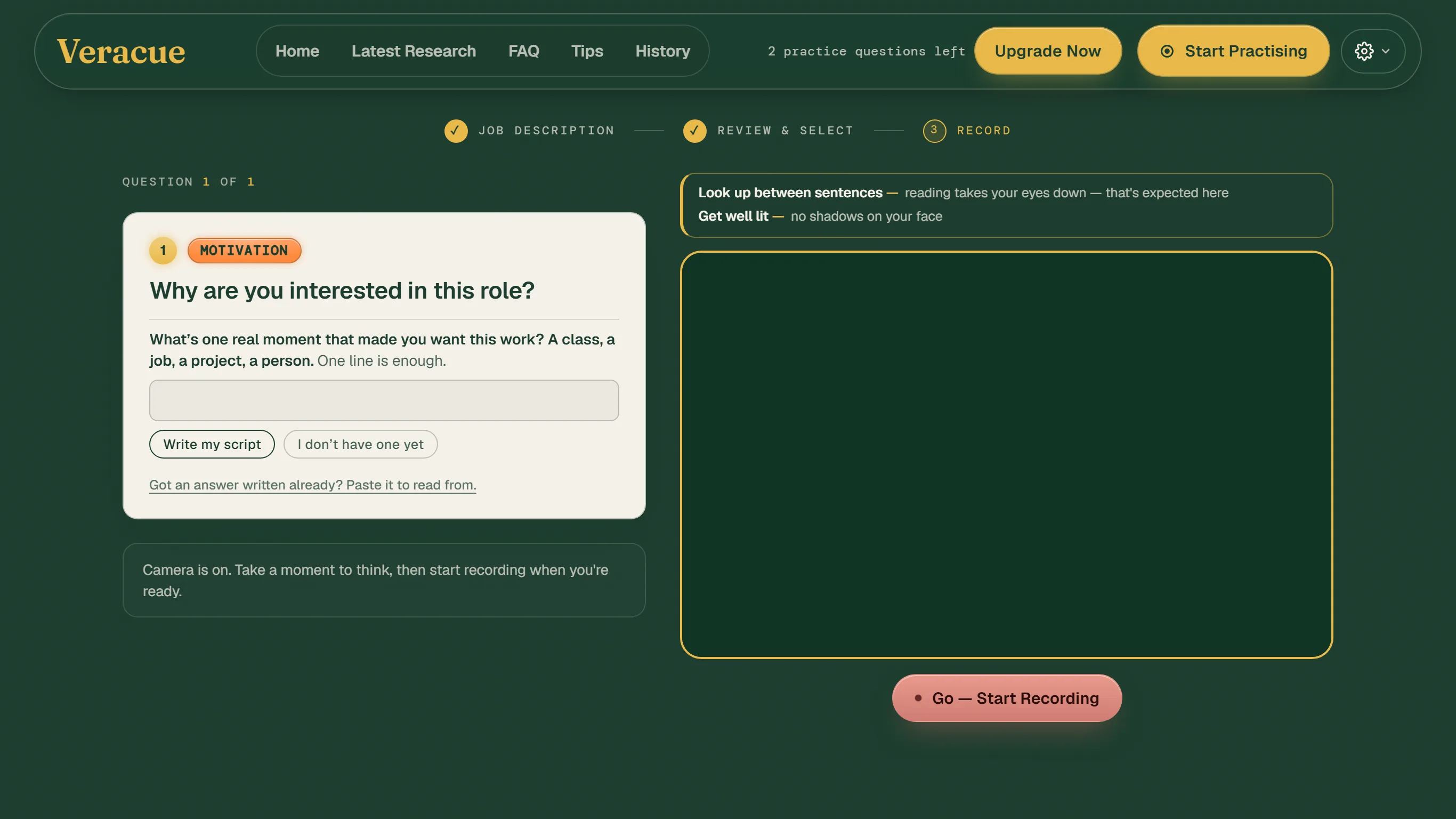
This question is where scripted answers fail most visibly: read out, a slogan sounds like a slogan. Say it once as you would in the room, then check the transcript for the three parts. Veracue scores what you said against a rubric, including whether a real example was in it, and tells you the one thing to fix first; on a motivation question it will ask you for the moment before it writes you a script, because a script without one is a starting point and nothing more.
Two answers are free when you practise your interview on camera with Veracue; the Pro, Interview Sprint and Premium plans add more answers, formal interviews and the Veracue Challenge.
Opens the practice page with “Why are you interested in this role?” loaded, the question bank’s wording of it. Two free answers with full Pro feedback; no card needed. New here? You’ll create an account first and land on the question.
Where does this advice come from?
From the sources below, from the question bank’s notes on what interviewers test with motivation questions, and from what practice answers on Veracue show.
- Job interview, Wikipedia: what interviewers assess and how impressions form.
- How to prepare for a clerkship interview, Veracue: the “why this firm” version of this question, with the find-and-replace test.
- How to answer “Tell me about yourself”, Veracue: the question that usually comes before this one.