What is the interviewer testing?
Whether your reason for law is your own, has survived three or four years of study, and points at this kind of practice rather than law in general.
By the time you reach a clerkship interview the firm knows your marks. “Why law?” is not a test of them. It is a test of whether you have thought about the work: what a lawyer in this firm does on a Tuesday, and whether that is what you want. Partners hear a lot of answers about justice and problem-solving, and most of them could have been given by a student who has never set foot in a firm. What they are listening for is a cause they can believe, a reason that has been tested against something real, and a line from it to commercial practice, or to whichever practice setting the firm is.
How should I structure the answer?
One real moment that made you want this work, what you have done since to test it, and why this kind of practice, in about a minute.
- The moment. The afternoon, the subject, the job or the person that made law more than a sensible choice. Told briefly and specifically: which class, which problem, what you noticed about yourself.
- The test. What you have done since that checked the interest against the work: a paralegal or clerk job, a moot, a clinic, a research assistant role, a conversation with a practitioner that changed your mind about something. Evidence that the reason held.
- Why this practice. Commercial law is a particular kind of lawyering, and a firm wants to hear that you know it: the client is a business, the problem is usually a decision rather than a dispute, the work is in a team. If the firm is government, legal aid or a specialist practice, this beat points there instead.
The same three beats answer “Why this firm?”, with the last one narrowed to something true about them: a practice group, a matter, a person you spoke to, the rotation structure. The clerkship guide has the find-and-replace test for that last beat.
What does a good answer sound like?
A specific moment, a real test of it, and a reason for commercial practice that shows you know what the work is; the example below shows the shape.
“I started law because it was the degree you did with my marks, and I would have said something about justice in first year. What changed it was a contracts assignment in second year where we were given a real supply agreement and asked which clause the buyer should have fought harder on. I spent a whole weekend on it and found I liked that the question had a right answer that mattered to someone’s business. Since then I’ve worked a day a week as a paralegal in a small commercial practice, mostly on leases, and the part I like most is the week before a deal closes, when the client rings with a question and the answer changes what they do. That is why commercial practice specifically: the client is a business making a decision, and the law is the tool, not the point. Your firm’s construction group is the reason I applied here, because the matters I’ve seen from the paralegal side are the kind that group runs from the other end.”
The example admits an ordinary start and then shows the reason being made, not announced. It names a class, a job and a kind of work, and the last sentence could only be about one firm.
What are the common mistakes?
Justice and problem-solving as the whole answer, a reason that fits any career, television, and an answer that never reaches commercial practice.
- “I’m passionate about justice.” It may be true. On its own it is the answer every applicant gives, and it sits awkwardly with an application to a commercial firm, whose clients are companies.
- Problem-solving, analytical thinking, attention to detail. Qualities, not reasons. Engineers, accountants and doctors would say the same. The moment is what makes the qualities yours.
- Television. If a show started it, say so and move on in one sentence to what you found when you looked at the real thing.
- Stopping at law. An answer that explains law and never reaches commercial practice leaves the interviewer to wonder why you are not at legal aid, the bar or a government department. Say why this kind of work.
- Reciting the firm’s values page. They wrote it. Tell them what you have done, and let it show the values.
How do I practise this question?
Record it on camera and read the transcript for the three beats: is there a moment, did you test it, and does the end reach this kind of practice?
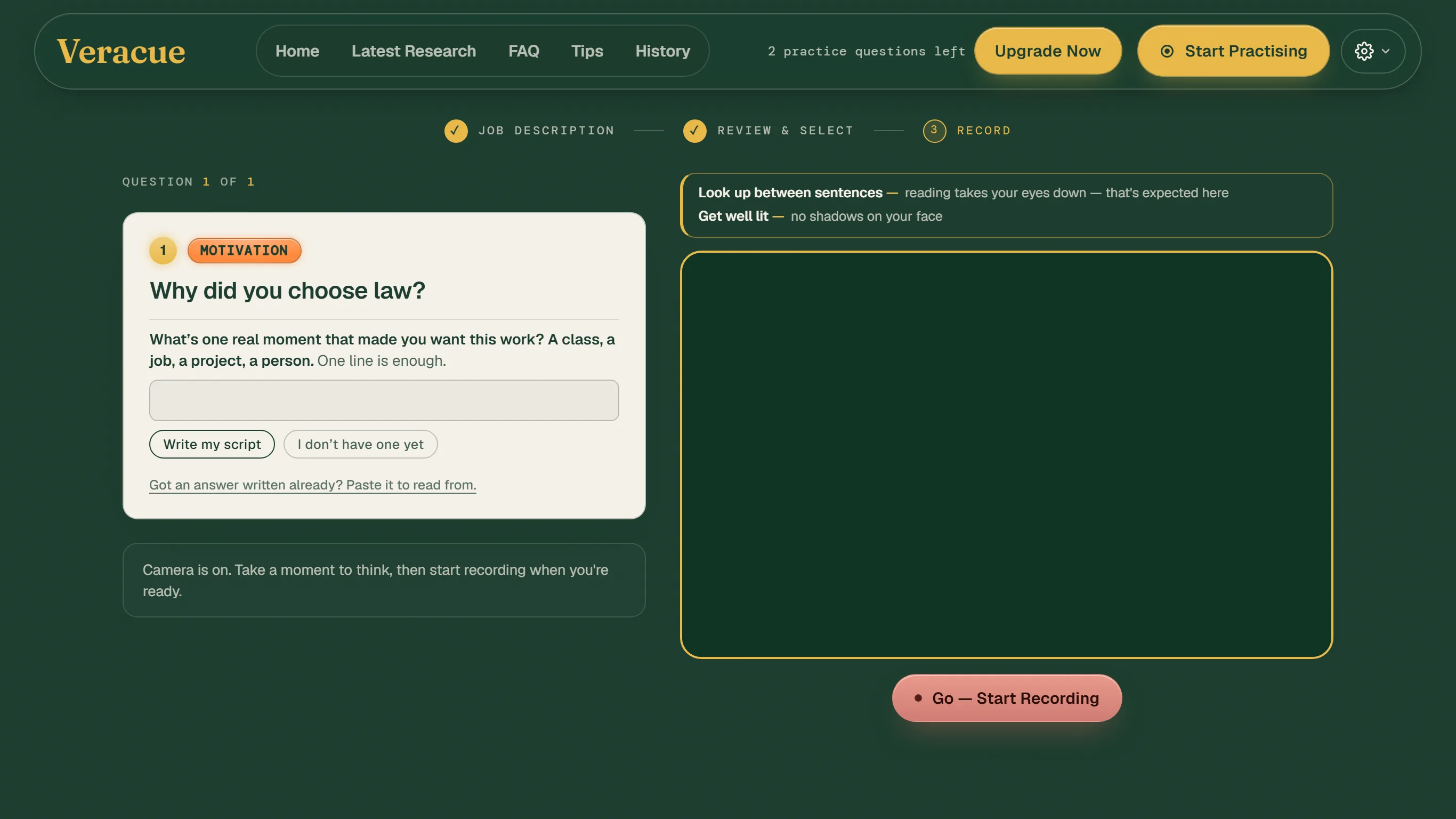
Motivation answers are where a rehearsed script shows most, because the interviewer is listening for something that sounds believed. Say it once as you would in the room, then check the transcript. Veracue scores what you said against a rubric, including whether a real example is in it, and tells you the one thing to fix first; on a motivation question it asks you for the moment before it writes a script, because a script without one is only a starting point.
Two answers are free when you practise your interview on camera with Veracue; the Pro, Interview Sprint and Premium plans add more answers, formal interviews and the Veracue Challenge.
Opens the practice page with “Why did you choose law?” loaded, the question bank’s wording of it. Two free answers with full Pro feedback; no card needed. New here? You’ll create an account first and land on the question.
Where does this advice come from?
From the sources below, from the question bank’s notes on what firms test with this question, and from what clerkship practice answers on Veracue show.
- Queensland Law Society, students, the Society’s page for Queensland law students.
- University of Queensland Law School, careers for current students, the careers resources one Queensland law school points its students to.
- Lawyers Weekly, careers, Australian legal-industry news, where the stories a commercial-awareness answer is built on run.
- Job interview, Wikipedia: what interviewers assess and how impressions form.
- How to prepare for a clerkship interview, Veracue: the whole interview, question type by question type.