What is the interviewer testing?
Whether you can work interdependently: what you did, what you handed to others and trusted them with, and how the group reached the goal.
A teamwork question is not asking whether you are nice to work with. It is asking for evidence that you have relied on other people and been relied on, and that the goal was reached because of how the group worked rather than in spite of it. The two follow-ups interviewers reach for say so: “What was your specific role?” and “How did you handle underperformance within the team?” The first catches an answer that stayed in “we”; the second catches one where everything went smoothly, which is rarely the whole story.
How should I structure the answer?
STAR, with the Task beat naming your role and the others’, one decision that depended on someone else, and a result for the group with your part in it.
- Situation, one or two sentences. The team, its size, the goal, and why it needed a team at all.
- Task, two sentences. Who did what, including you. This is the beat most teamwork answers skip, and it is the one that proves interdependence.
- Action, most of the answer. Two or three decisions of yours that involved other people: something you handed over and trusted, something you asked for, something you changed because of what a teammate said. If someone fell behind, what you did about it.
- Result, two sentences. What the group delivered, and the piece of it that was yours.
Say “I” for your decisions and “we” for the group’s results. An answer that never says “I” gives the interviewer nothing to assess; one that never says “we” was not a teamwork story.
What does a good answer sound like?
A real team with named roles, a decision that depended on someone else, and a result the group reached; the example below shows the shape.
“Last year four of us ran the registration desk for a two-day student conference. I was coordinating, one person built the sign-in sheet, one handled the name badges and one dealt with the sponsors’ tables. On the first morning the sign-in sheet didn’t match the badge list, because the two had been built from different versions of the attendee spreadsheet. Rather than fix it myself, I asked the two of them to sit together for twenty minutes and reconcile the lists while I took the desk alone, because they knew their own files and I didn’t. We opened fifteen minutes late, but every badge matched a name, and on the second morning we ran a single shared list. My part was deciding who did what and standing in front of the queue while they did it; the fix itself was theirs.”
The example says what each person did, shows one decision that relied on other people, admits a cost, and ends with the group’s result and the speaker’s own part in it.
What are the common mistakes?
A story where you did everything, a story where nobody did anything in particular, a teammate cast as the villain, and no result.
- All “I”. A team story in which you rescued the project alone is a leadership story with a teamwork label. Interviewers notice the swap.
- All “we”. “We worked really well together and got it done.” No roles, no decisions, nothing to assess.
- Blaming a teammate. Someone falling behind is a good story if the answer is about what you did; it is a bad one if it is about them.
- No result. The goal was the point of the question. Say whether it was reached, and what your part was.
- Only pleasant stories. A team that never disagreed about anything did not need much teamwork. A disagreement handled well is better evidence.
How do I practise this question?
Answer it out loud on camera, read the transcript back, and fix one thing at a time.
The answer in your head and the answer that leaves your mouth are different things, and the transcript is where you find out which parts arrived. Veracue gives you the transcript, the length, your pace and filler words, and what you said scored against a rubric, with the one thing to fix first.
Two answers are free when you practise your interview on camera with Veracue; the Pro, Interview Sprint and Premium plans add more answers, formal interviews and the Veracue Challenge.
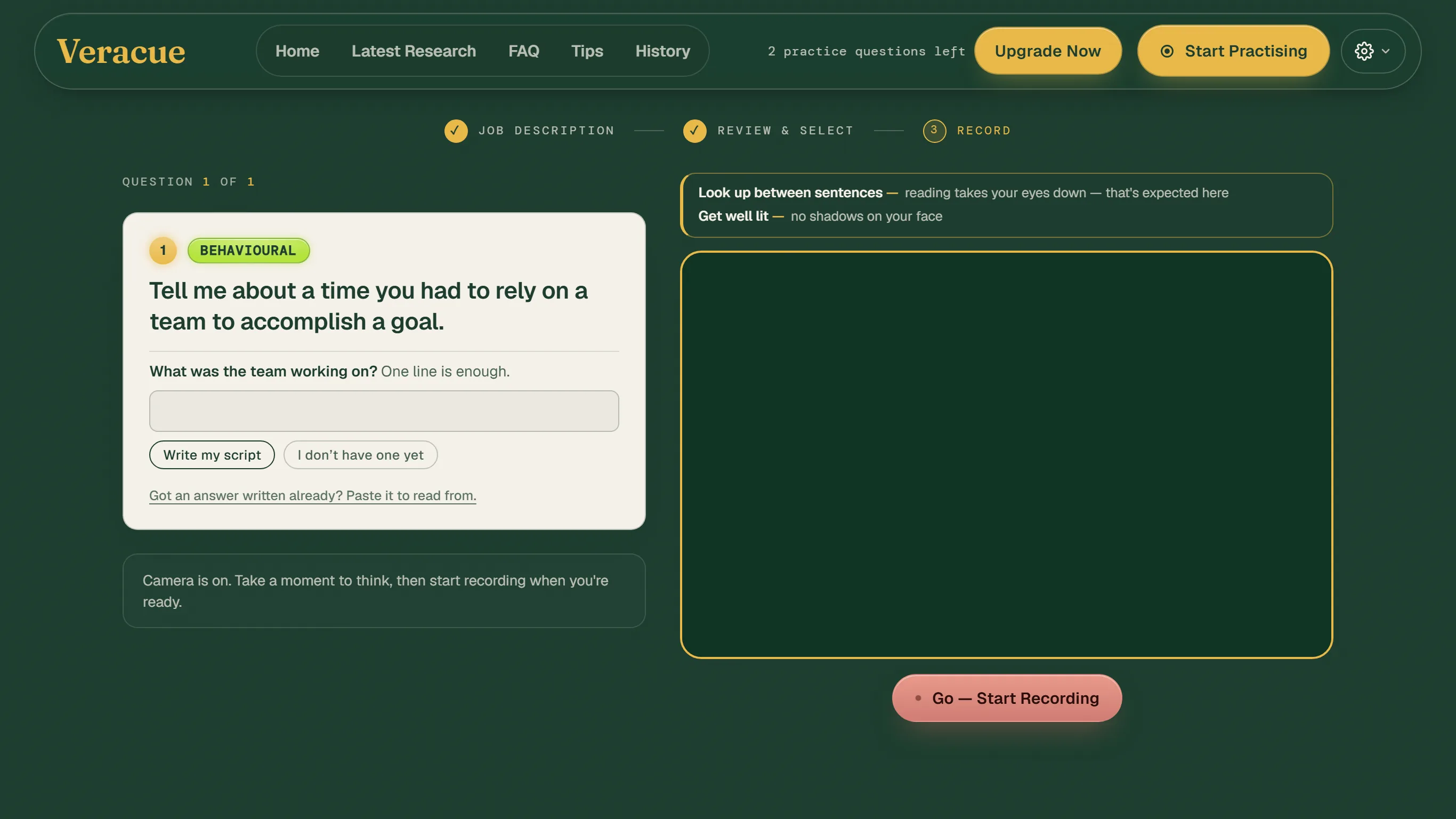
Opens the practice page with “Tell me about a time you had to rely on a team to accomplish a goal.” loaded, the question bank’s wording of it. Two free answers with full Pro feedback; no card needed. New here? You’ll create an account first and land on the question.
Where does this advice come from?
From the sources below, from the question bank’s notes on what interviewers test with this question, and from what practice answers on Veracue show.
- Situation, task, action, result, Wikipedia: the STAR structure and where it came from.
- Job interview, Wikipedia: what interviewers assess and how impressions form.
- Behavioural interview questions: how to structure answers that land, Veracue: STAR in full, with before-and-after examples.