What is the interviewer testing?
How you behave when someone disagrees with you: whether you understand their position, own your part, and reach something workable without the relationship breaking.
Conflict here means an ordinary disagreement at work, with two people who each had a point. The interviewer wants to see your style: do you go quiet and resent it, go loud and win it, or do the slower thing of finding out what the other person needed? The follow-ups are the giveaway: “What would you do differently now?” asks whether you can see your own part, and “How did the relationship change after?” asks whether you handled it in a way that could be repeated with the same person next week.
How should I structure the answer?
The disagreement in one sentence with both positions fair, what you did to understand theirs, what you proposed, the outcome, and the relationship afterwards.
- The disagreement. One sentence, stated so that the other person would recognise it. If they would not, you are telling a villain story.
- What you did first. Usually a conversation, in private, where you asked rather than argued. Say what you found out.
- What you proposed. The compromise or the change, and why it met both needs.
- The outcome and the relationship. What happened, and what working with that person was like afterwards.
- Your part. One sentence on what you would do differently. It makes the whole answer more believable.
What does a good answer sound like?
Two reasonable people, a conversation that found the real issue, a workable change, and an honest line about your own part; the example below shows the shape.
“At the cafe where I worked through uni, the other closing supervisor kept redoing my end-of-night checklist after I’d signed it off, which meant we were both leaving an hour late and I was annoyed about it. I asked her about it one evening before the rush instead of during close. It turned out the manager had told her, not me, that the previous closer had missed the fridge temperatures twice and she had been told to double-check. So we weren’t disagreeing about standards; I just didn’t know there was a problem. We agreed that I would photograph the fridge log and send it to her as I did it, and she would stop re-checking the rest. Closes went back to normal within a week and we covered each other’s shifts for the rest of the year. What I would do differently is ask the first time it happened, not the fifth.”
The example gives the other person a legitimate reason, finds it through a question rather than a confrontation, lands on a change both could live with, and owns the delay in raising it.
What are the common mistakes?
Claiming you never have conflict, telling a story where you were simply right, picking a fight with a manager, leaving it unresolved, and no self-reflection.
- “I get on with everyone.” Everyone has had a disagreement at work. The claim reads as either untrue or as conflict-avoidant, and neither helps.
- The villain story. If the other person is unreasonable from start to finish, the interviewer wonders how you would describe them.
- The boss story. A disagreement with a manager can work, but only if it was raised respectfully and the outcome was theirs to decide.
- No resolution. “We agreed to disagree” is an ending only if the work still got done, and you should say how.
- No part of your own. The follow-up will ask. Have the sentence ready.
How do I practise this question?
Answer it out loud on camera, read the transcript back, and fix one thing at a time.
The answer in your head and the answer that leaves your mouth are different things, and the transcript is where you find out which parts arrived. Veracue gives you the transcript, the length, your pace and filler words, and what you said scored against a rubric, with the one thing to fix first.
Two answers are free when you practise your interview on camera with Veracue; the Pro, Interview Sprint and Premium plans add more answers, formal interviews and the Veracue Challenge.
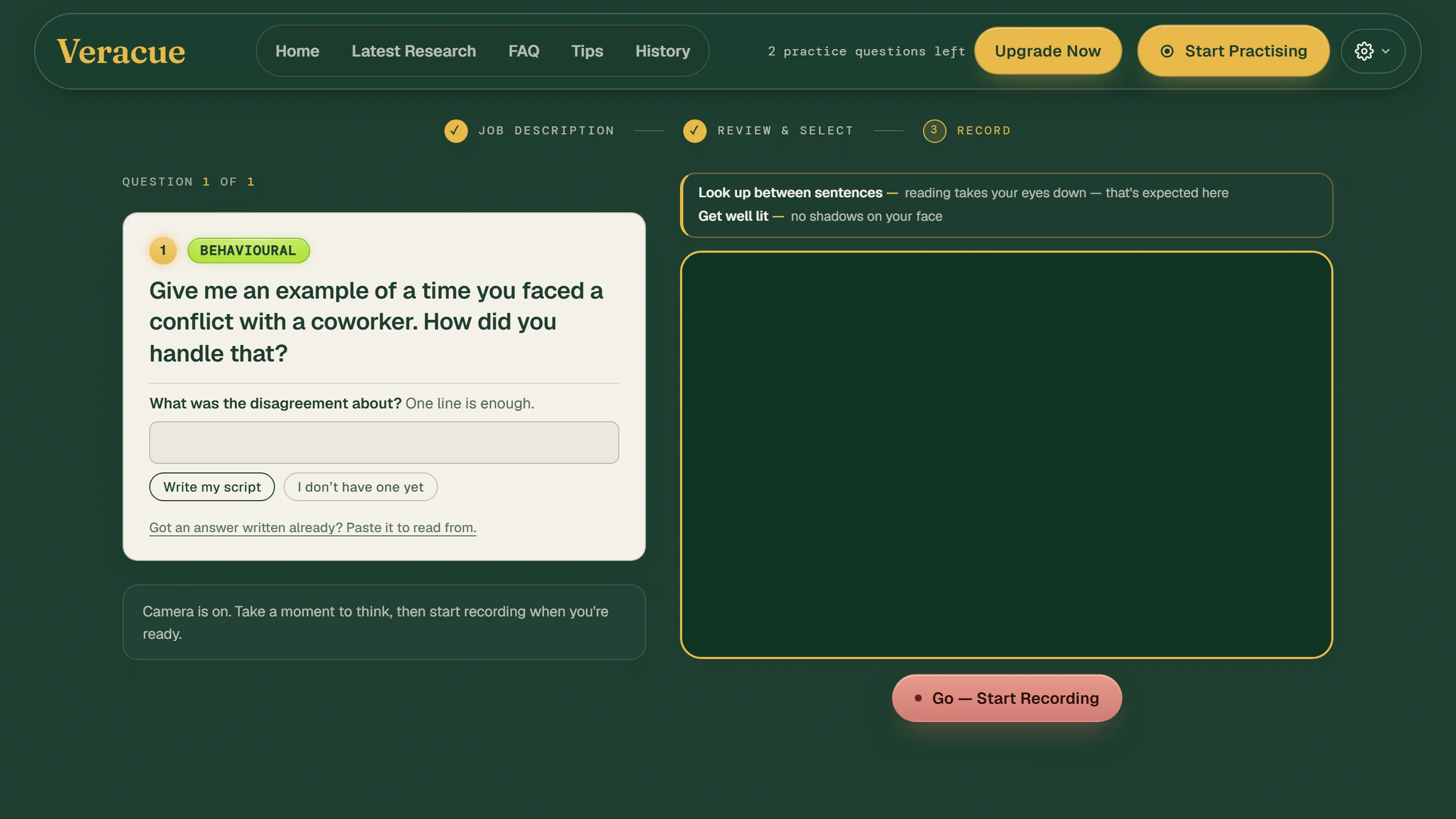
Opens the practice page with “Give me an example of a time you faced a conflict with a coworker. How did you handle that?” loaded, the question bank’s wording of it. Two free answers with full Pro feedback; no card needed. New here? You’ll create an account first and land on the question.
Where does this advice come from?
From the sources below, from the question bank’s notes on what interviewers test with this question, and from what practice answers on Veracue show.
- Situation, task, action, result, Wikipedia: the STAR structure and where it came from.
- Job interview, Wikipedia: what interviewers assess and how impressions form.
- Behavioural interview questions: how to structure answers that land, Veracue: STAR in full, with before-and-after examples.