What is the interviewer testing?
Whether you have thought about the job beyond the interview, what you actually care about, and whether you listened to anything they said in the last half hour.
“Do you have any questions for us?” is still the interview. A good question tells the interviewer what you are weighing up and shows that you have pictured yourself doing the work. A question that follows from something they said shows you were listening. “No, I think you’ve covered everything” tells them the conversation is over for you, which is rarely the impression you want to leave.
How should I structure the answer?
Two or three prepared questions about the work, one that follows from the conversation, and the one you sincerely want answered before you would accept.
- Prepared, about the work. What a first-year’s week looks like, how work is allocated, how feedback is given, what the best people in the role do that others do not. Two or three, written down, so nerves cannot take them.
- One from the conversation. Something the interviewer mentioned that you want to hear more about. It is the question that proves you listened.
- The sincere one. The thing you would want to know before saying yes. Asked plainly, it reads as someone taking the decision seriously.
- Logistics last, or not at all. “When will I hear?” is fine as the final question. Salary and leave belong to the offer stage unless they raise it.
What does a good answer sound like?
Three questions: one about the work, one from the conversation, one sincere; the example below shows the shape.
“Three, if there’s time. You mentioned that graduates rotate after six months: how is the second rotation decided, and how much say does the graduate have? Second, what does a first-year in this team actually do in a typical week; I would rather know what the ordinary days look like than the highlights. And the one I genuinely want to know: what do the people who have done well in this role in their first two years have in common that you could see at interview?”
The first question follows from something the interviewer said, the second asks about the real work, and the third is sincere and gives the interviewer something they enjoy answering.
What are the common mistakes?
Having no questions, asking only about pay and leave, asking things the website answers, asking too many, and asking whether you got the job.
- “No, you’ve covered everything.” Even if true, it closes the conversation on a flat note. Have one ready that cannot be covered.
- Pay, leave, hours, first. Fair questions, wrong moment. They belong to the offer.
- The website question. “What does the firm do?” tells them you did not look.
- Seven questions. Read the room. Three is plenty; one, asked well, is enough.
- “How did I do?” Puts the interviewer on the spot and rarely gets a true answer.
How do I practise this question?
Answer it out loud on camera, read the transcript back, and fix one thing at a time.
The answer in your head and the answer that leaves your mouth are different things, and the transcript is where you find out which parts arrived. Veracue gives you the transcript, the length, your pace and filler words, and what you said scored against a rubric, with the one thing to fix first.
Two answers are free when you practise your interview on camera with Veracue; the Pro, Interview Sprint and Premium plans add more answers, formal interviews and the Veracue Challenge.
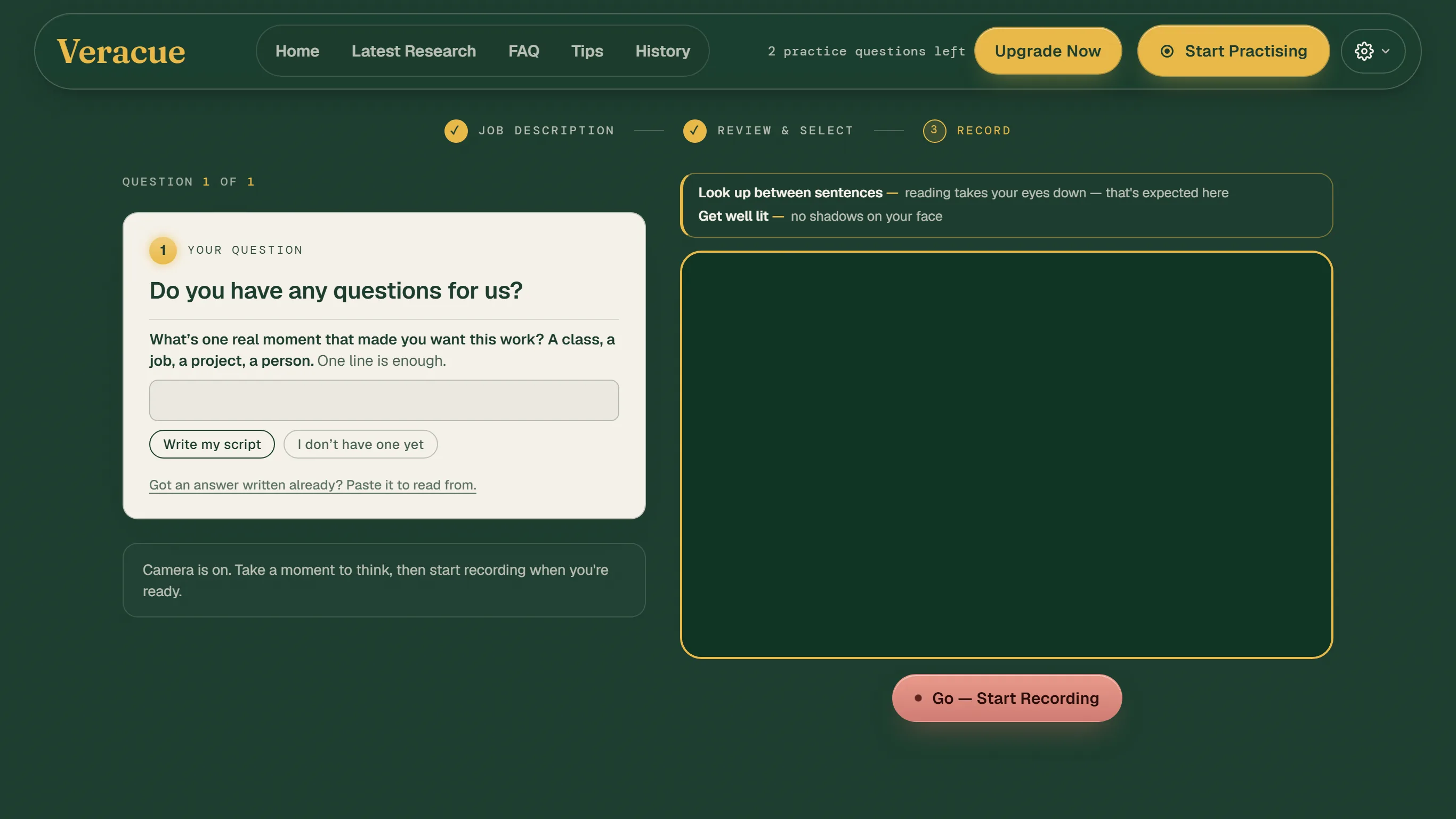
Opens the practice page with “Do you have any questions for us?” loaded as a typed question (the bank has no entry for it), so you can say your three out loud and hear how they land. Two free answers with full Pro feedback; no card needed. New here? You’ll create an account first and land on the question.
Where does this advice come from?
From the sources below, from the question bank’s notes on what interviewers test with this question, and from what practice answers on Veracue show.
- Job interview, Wikipedia: what interviewers assess and how impressions form.
- How to prepare for a clerkship interview, Veracue: the whole interview, question type by question type.
- Structuring an answer under pressure, Veracue: the shapes that survive nerves.